Yettel

Evolving Web and App Interfaces for a Seamless User Journey

2020-
A person browsing the Yettel website on a laptop and smartphone.
Play

Project Goal

Yettel Hungary approached Virgo with the task of a comprehensive rebranding of its digital platforms including both web interfaces and the mobile application to align with its new brand identity. The assignment was distinguished by the fact that, at the outset of the project, both the new name and the visual direction were strictly confidential, and the rebranding itself was known only to a very select group of people.

The objective of the project went far beyond a simple visual makeover. The task was to ensure that Yettel’s entire digital presence would be ready for the moment of the rebranding in a way that it is functionally stable, visually consistent, and commercially secure. It was essential that users entering the new Yettel-interfaces experienced no disruption either in access to services or in the usual user journeys and processes.

Virgo supported the implementation end to end, providing Product Design, UX/UI design, front-end and back-end development, as well as continuous technical consultancy. The aim was to establish a scalable digital foundation that would not only enable the rebranding but also support Yettel’s business and product development goals in the long term.

There are projects that make history in the life of a company. The Telenor–Yettel rebranding was clearly one of them. It was not only a complete visual identity change, it all took place within a complex digital ecosystem that had been operating for years, across web and mobile applications, serving millions of users, with no margin for error.

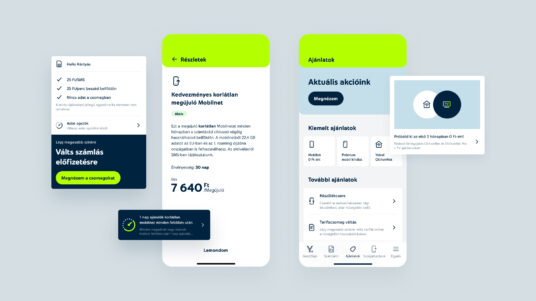
Four smartphone screens showing the Yettel app’s user interface

The Foundations of a Successful Collaboration

The collaboration between Virgo and Yettel (formerly Telenor) did not begin with the rebranding itself, but much earlier, in 2017. The rebranding was already part of a long-term partnership. From the very beginning, our collaboration had been based on the approach that business goals and user experience should not come at each other’s expense, but rather reinforce one another.

Our collaboration began with the renewal of Telenor’s web interface. This had been attempted by another team previously, but without success. It is no coincidence that in-house the project was named Phoenix, as it was an initiative reborn after a previous failure, this time built on more conscious planning and stronger methodological foundations.

We would like to create something that is good for the business and good for the users — that’s the goal at the end of the day.
Adrián Balla Business Development Consultant, Virgo

One of the greatest challenges was the tight deadline combined with the sheer scale of the system. Development took place in a brownfield environment, requiring integration with existing systems that had been in operation for years, while living with the consequences of previous technological and business decisions. All of this had to be achieved in a way that ensured the possibility of future expansion and development.

In the initial phase, the focus was deliberately not on innovation or impressive new features. The primary objective was the stable migration of business-critical core elements into the new system, including:

  • product lists and product pages,

  • browsing and selection flows,

  • ordering and payment processes,

  • and SIM card activation, one of the most sensitive operational points for a telecommunications company.

In these functions, there was no room for compromise: any error would have had immediate business and user-facing consequences. Stability and reliability therefore took priority throughout the entire project.

Throughout the project, we had to face not only technological but also methodological challenges. The “user stories” recorded in Telenor’s own Jira system were not, in fact, classic user stories, but rather complete user journeys and process descriptions. This caused significant difficulties during the handover process, as the client wished to validate delivery based on these items, while development tasks were structured differently, broken down into much smaller units.

This caused a major headache for both sides for a long time. Eventually, however, a mapping logic was established that built a bridge between the two approaches, making the system testable, deliverable, and meaningful from a business perspective. This kind of flexibility and shared learning ultimately added far more value to the project than a strictly “textbook” Scrum process could have.

The work was not limited only to visible front-end changes. In parallel, the technical foundations were modernized too, meaning PHP and database version upgrades as well as infrastructure and operating system enhancements.

This technical modernization went deep and often delivered results that were not immediately visible, yet it was one of the project’s greatest challenges. In a system of this scale, “working on the engine” is always risky, but unavoidable. The goal was that users would not notice any of it. These invisible yet critical interventions ensured stable and sustainable operation.

This was an all-encompassing effort, where you couldn’t just fix only one segment of the system.” Due to the complexity of the challenge, the team often compared themselves to pop-culture heroes — Jedi, MacGyver, or Chuck Norris — and for good reason.

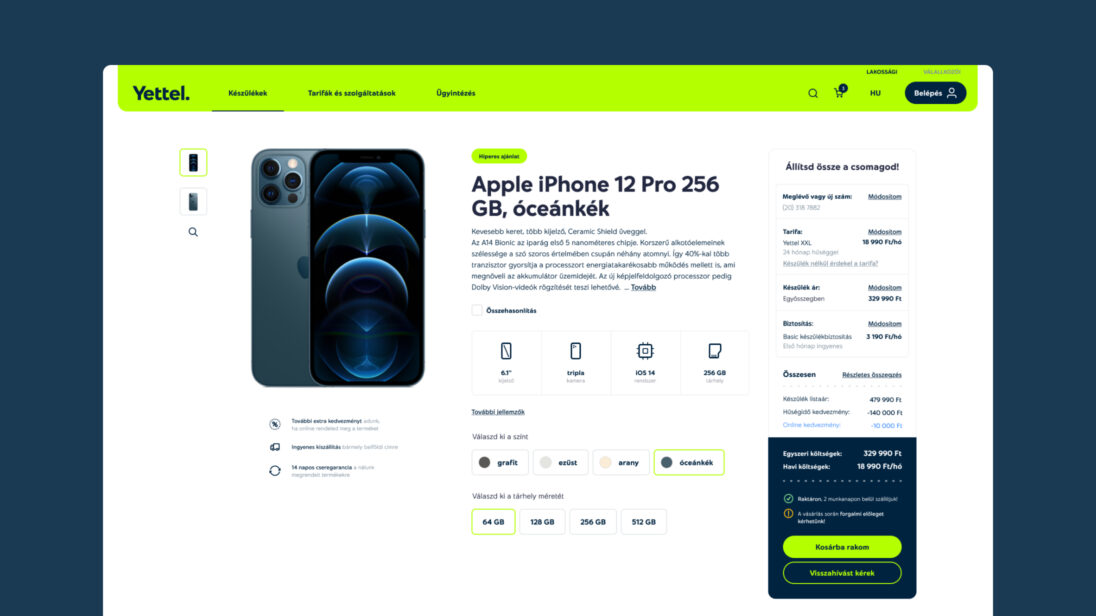
A product detail page for an Apple iPhone is displayed on the Yettel website.

Rebranding – When Even the Name Could Not Be Spoken

In 2022, Telenor underwent a complete brand and visual identity transition. The project was subject to extreme confidentiality: separate NDAs, isolated communication channels, and code names (YETI (from Yettel), Voldemort (He-Who-Must-Not-Be-Named), Rembrandt (because of rebranding)) were part of everyday work.

Based on the global brand guidelines, Virgo’s design team created the localized visual implementation for the Hungarian market across both web and mobile applications. Due to tight deadlines, there was no room for functional changes at this stage — the focus was on precise, consistent, and flawless execution of the new visual identity.

We were provided with a global brand identity and concept, and our task was to create the Hungarian redesign based on these foundations.
Roland Fenyvesi Lead Product Designer, Virgo
Yettel shopping cart page and a home internet service page.

Design Process

1. Delivery Strategy and Team Setup

At the outset of the design and implementation process establishing a well-thought-out delivery strategy played a key role. Dedicated experts from both Virgo and Yettel were involved with clearly defined responsibilities and decision-making mechanisms.

The jointly developed roadmap milestones did not only structure the project timeline but also ensured that parallel design and development tasks remained synchronized. This coordination was essential given the tight deadlines and the high level of business risk.

2. UX and UI Design

  • UX Optimization
    As nearly every page had to be rebuilt, the team had the opportunity to rethink and refine existing user journeys. Beyond the visual renewal, strong emphasis was placed on usability, clarity, and conversion support.

    New pages and components were created to support Yettel’s new tariff structure and service portfolio, while remaining aligned with established user behaviors.

  • UI Design
    All pages and components had to be designed in accordance with Yettel’s new digital brand guidelines. Work on the web and mobile application interfaces progressed in parallel, ensuring visual and functional consistency across platforms right from the design phase.
  • Design System
    Throughout the project, the design system functioned not as a static document but as a living tool. It was continuously expanded with new components, while existing elements were updated to ensure long-term scalability and maintainability.
  • Handoff
    Special focus was placed on the handoff process between design and development. Regular internal meetings were held with the development team, where the reasoning behind design decisions and potential edge cases were thoroughly discussed. Detailed developer documentation supported consistent implementation and significantly reduced the risk of misunderstandings.
  • Go-Live
    The go-live was “boring”, which was one of the project’s greatest successes. There was no panic, no late-night bug fixing, and no firefighting. Some of the most frequently asked questions were: “Was that it? Are we already done?” For a business-critical system where even a single error could result in large-scale user impact, an incident-free launch meant the best possible outcome.Behind the scenes were months of precise planning, development, and testing, resulting in a transition that users barely noticed. Yettel’s website and mobile application launched on time, with full functionality and a unified visual identity.

    On the day of the rebranding everyone was feverishly checking everything: code, databases, interfaces. One question hung in the air: Are we absolutely sure there isn’t a forgotten “Telenor” word or logo left anywhere?

    One of the first checkpoints was Google. The top result: Wikipedia, still displaying the old logo. Rapid phone calls, quick reactions – and the switch was completed on one of the world’s most well-known online encyclopedias as well.

Results and Key Takeaways

As a result of the project:

  • Yettel’s digital platforms were placed on stable, modern foundations, 
  • users received a consistent experience across web and mobile platforms, 
  • several solutions from the Hungarian implementation were later adopted internationally.
A very important takeaway and a great validation for us is that we are capable of working on a brand of this scale, delivering high quality results on time.
Adrián Balla Business Development Consultant, Virgo

One of the most important characteristics of the Yettel–Virgo relationship was equality. This was not a classic client–vendor relationship, but a true partnership. Yettel underwent a lot of changes, and Virgo did its best to act as a stable, reliable anchor within a highly dynamic environment.

This approach proved successful: the Hungarian implementation included multiple solutions that were later adopted by other countries. This is not only a professional recognition but a clear validation that the team is able to create value at an international level. 

Perhaps the project’s greatest achievement is that it has been proved that Virgo is capable of working on the digital presence of a global brand, delivering high quality on time, and without compromises. The web and mobile platforms operate reliably, the rebranding was executed seamlessly, and users received a cohesive, modern experience.

The takeaway is clear: truly large-scale projects are not only about technology or design. They are about trust, communication, flexibility, and the ability of a team to think together with the client — even when the project’s name itself cannot yet be spoken.

Our work